I’ve found that Scandinavian kitchens aren’t actually minimal; they’re strategically restrained.
You’ll discover that designers like Norm Architects layer soft whites, pale greys, and light timber to create spaces that feel both spacious and lived-in.
The real challenge, though, isn’t choosing these neutral foundations. It’s understanding how to add warmth while maintaining that signature Nordic simplicity.
Let me show you exactly how the best kitchens accomplish this balance.
Build Your Palette: Neutrals First, Natural Warmth Next
The foundation of Scandinavian kitchen design rests on a deliberately restrained color palette, one that you’ll build by starting with neutrals and layering in natural warmth. Begin with light whites, soft beiges, and pale greys; these create the bright, airy backdrop essential to Scandinavian design.
Next, introduce wood cabinetry in light-toned woods like beech or oak, paired with timber worktops. This combination establishes cohesion without visual clutter. Stone benchtops or marble backsplashes add organic texture that complements your wood selections.
When you select timeless finishes with low-maintenance properties, your palette remains harmonious as design trends evolve. Natural warmth emerges through materials rather than bold color choices, allowing your kitchen to reflect the understated sophistication characteristic of Scandinavian interiors.
Wood as Your Anchor: The Scandinavian Design Choice
Why does wood function as the cornerstone of Scandinavian kitchen design? It’s because light-toned wood establishes both visual warmth and natural authenticity that define the style. I’d recommend considering these foundational elements:
- Light woods like birch, oak, and whitewashed pine create airy, uncluttered spaces
- Timber-look laminates and Tasmanian oak adapt the aesthetic to local preferences
- Wood spans cabinets, countertops, shelves, and dining surfaces for unified design
- Textured wood balances with contrasting materials: painted metals or stone, preventing monotony
Pairing light-toned wood with white surfaces maintains that signature calm aesthetic. This natural materials approach grounds your kitchen in Scandinavian philosophy: honest design that prioritizes functional beauty.
The result is a unified look that feels both deliberate and naturally lived-in, inviting you into spaces where warmth comes from authenticity rather than ornamentation.
Scandinavian Storage Secrets: Minimalism That Works
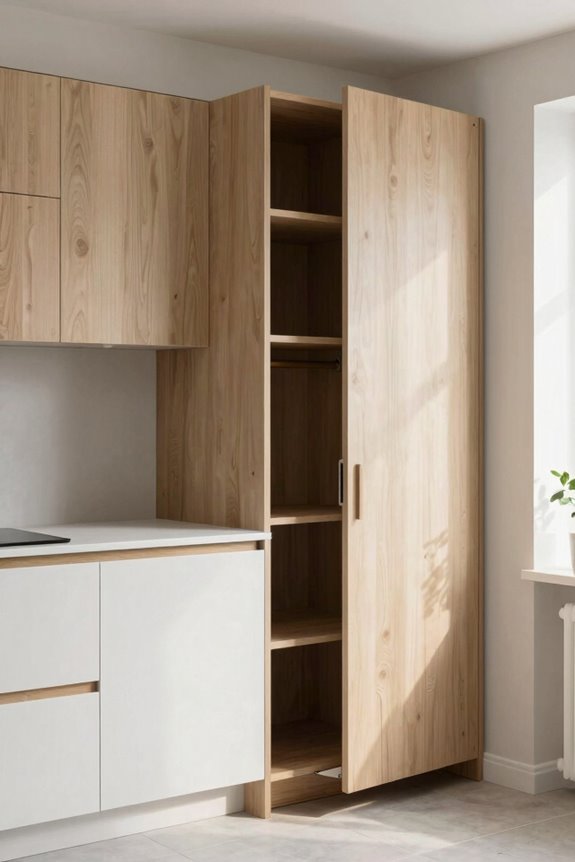
I’ve discovered that Scandinavian kitchens achieve their signature calm through hidden organization systems: think push-to-open cabinetry, integrated appliances behind matching panels, and floor-to-ceiling units that maximize vertical space without visual clutter. Your countertops remain decluttered because pull-out racks, deep drawers with custom dividers, and bespoke joinery tuck away daily essentials, while open shelving displays only carefully selected items like uniform ceramic vessels and glassware arranged with purposeful consideration.
This strategic zoning between concealed and exposed storage creates the breathing room that defines the aesthetic, turning functionality into invisible architecture.
Hidden Organization Systems
How do Scandinavian designers achieve their signature minimalist aesthetic without sacrificing everyday functionality? They master hidden storage systems that keep essentials accessible yet invisible. This approach creates kitchens as calm spaces where form and practicality coexist.
- Flat-front doors and push-to-open mechanisms eliminate visible hardware, maintaining clean sight lines
- Integrated appliances behind matching panels blend seamlessly with cabinetry, erasing visual interruption
- Pull-out pantries and concealed waste bins provide instant access without countertop chaos
- Floor-to-ceiling cabinetry with pull-out racks maximizes vertical space while preserving open sightlines
These solutions define Scandinavian kitchens. When strategically deployed, hidden storage eliminates clutter while supporting daily tasks.
Open shelving complements this system by displaying only curated ceramics and uniform jars, creating deliberate vignettes rather than cluttered displays. This balance between concealment and accessibility defines minimalist, clutter-free design.
Decluttered Surface Design
The Scandinavian kitchen thrives on restraint; surfaces remain largely bare, with only essential items claiming countertop real estate. I’ve observed that this decluttered approach isn’t about sacrifice. It’s strategic minimalism.
You’ll notice open shelving displays curated ceramics and uniform glass jars, while flat-front cabinetry with push-to-open mechanisms conceals everything else. This balance creates an airy aesthetic without compromising functionality.
| Element | Purpose | Placement | Material | Visual Impact |
|---|---|---|---|---|
| Open Shelving | Display essentials | Upper walls | Wood/metal | Breathable space |
| Hidden Storage | Conceal clutter | Lower cabinets | Laminate/oak | Clean lines |
| Push-to-Open | Minimalist hardware | Cabinet fronts | Stainless steel | Seamless finish |
| Uniform Containers | Organized visibility | Shelves | Ceramic/glass | Unified appearance |
| Countertops | Workspace only | Working surfaces | Marble/wood | Uncluttered calm |
This philosophy creates a kitchen that reflects purposeful, considered choices in every detail.
Scandinavian Approach to Lighting: Brightness and Simplicity
Why does Scandinavian design prioritize natural light above nearly all other considerations? Because brightness fundamentally shapes how we experience space. I’ve found that maximizing daylight reduces reliance on artificial lighting while creating an inviting kitchen that feels larger and more connected to the outdoors.
- Install large windows with minimal dressings to flood work zones with unobstructed daylight
- Choose white cabinets and reflective stone countertops that amplify natural brightness throughout the room
- Incorporate skylights or floor-to-ceiling glass to brighten interior areas lacking direct window access
- Select light wood finishes and matte textures that complement minimalism without competing for visual attention
Open-plan layouts enhance these efforts by maintaining clear sightlines. White cabinetry paired with pale surfaces creates that characteristic Scandinavian luminosity; a design strategy that makes even modest kitchens into bright, breathable environments where simplicity and functionality coexist seamlessly.
Color in Scandinavian Design: Restraint Over Boldness
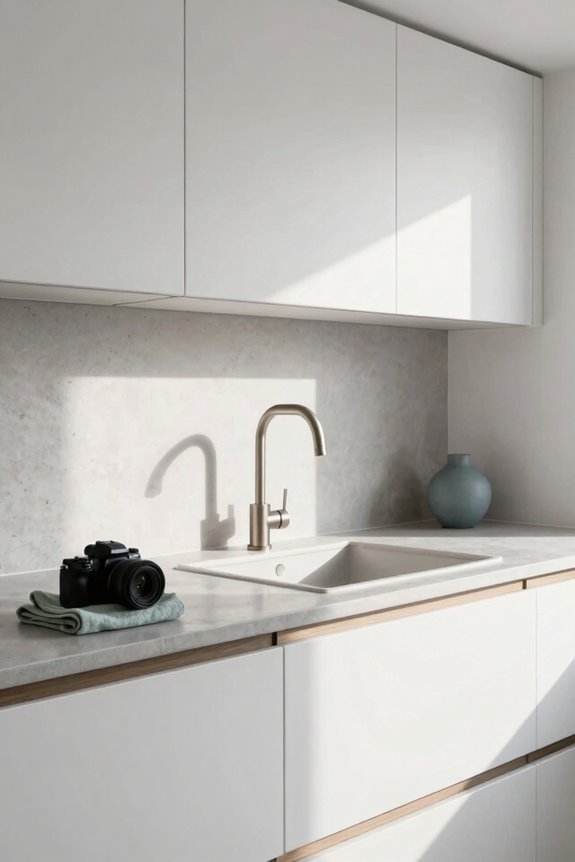
Where does Scandinavian design’s restraint with color originate? It stems from a philosophy that emphasizes simplicity and purposefulness, a belief that neutral foundations create calm, functional spaces. Scandinavian color palettes rely on whites, soft greys, and warm creams as anchors, paired with light natural wood tones. This restraint expands perceived space while maintaining visual clarity.
White-on-white surfaces with matte finishes establish sophisticated depth without overwhelming inhabitants. When color does appear, it’s deliberate: navy, indigo, or oceanic pastels serve as grounding accents rather than focal points. This minimalism extends beyond aesthetics, supporting clutter-free surfaces and emphasizing natural materials like stone and textiles.
The result is a cohesive, breathing environment where restraint becomes strength. Kitchens become sanctuaries of simplicity through this thoughtful approach to design.
Efficiency the Nordic Way: Kitchen Workflow Design
I’m going to show you how Nordic designers optimize kitchen efficiency through three interconnected strategies. You’ll notice that minimalist layouts position your prep zones near the sink and cooking areas to reduce unnecessary steps, while push-to-open cabinetry and integrated appliances like Miele or Gaggenau maintain uncluttered countertops that speed up daily tasks.
Natural light from strategically placed windows, combined with light-reflecting materials such as white oak or pale stone surfaces, enhances visibility in work zones and sharpens your accuracy when handling ingredients and equipment.
Minimalist Layout Principles
The Nordic kitchen’s efficiency doesn’t happen by accident; it’s the result of deliberate spatial planning that prioritizes workflow over decoration. When you embrace Scandinavian layout principles, you’re adopting a mindset where every element serves a purpose.
I’ve found that minimalism combined with open-plan design creates clean sightlines that guide movement naturally between zones. Here’s what makes this approach work:
- Storage optimization through concealed cabinetry keeps counters clear and visually calm
- Floor-to-ceiling cabinets maximize vertical space without consuming horizontal flow
- Push-to-open panels eliminate hardware clutter while maintaining accessibility
- Natural light through large windows amplifies the sense of openness
This spatial strategy creates an efficient workspace where form and function align seamlessly, resulting in the uncluttered environment that defines Nordic design.
Natural Light and Flow
Natural light functions as both a design element and a performance tool in Scandinavian kitchens, where you’ll find it strategically utilized to enhance workflow efficiency and spatial perception. Large windows positioned over work zones and islands brighten productive areas while reducing artificial lighting dependency. Skylights amplify daylight penetration, creating an airy space that feels expansive and inviting.
Light-reflecting surfaces, including white cabinetry, pale countertops, and polished finishes, bounce illumination throughout the open-plan layout, maximizing brightness from every angle. This approach maintains clear sightlines between cooking, dining, and living zones, enabling movement and connection. Strategic layering of natural daylight with soft, diffused artificial lighting sustains warmth and usability as daylight fades.
The result: kitchens that feel both visually spacious and functionally efficient across all hours.
Hidden Storage Solutions
Scandinavian kitchens don’t hide away their efficiency; they hide away their stuff. You’ll find that concealed panels and grip-doors in warm gray tones maintain visual calm while maximizing functionality. I’ve observed how handleless drawers and push-and-open systems eliminate visual interruption, creating seamless surfaces.
Consider these hidden storage strategies:
- Floor-to-ceiling cabinetry with integrated panels preserving open sightlines
- Grip-doors concealing appliances within dark oak aesthetics
- Handleless drawer systems optimizing vertical organization
- Matching fronts disguising storage depth without breaking visual flow
This clutter-free design approach supports Nordic workflows. When your kitchen contains purposeful, out-of-sight organization, you’re not just designing space. You’re cultivating the calm efficiency that defines Scandinavian living. Hidden storage becomes invisible infrastructure supporting your daily rhythm.
Keep It Cozy: The Warmth Minimalism Needs
Minimalism doesn’t mean cold or sterile, and that’s where hygge—the Danish concept of coziness and contentment—becomes your kitchen’s greatest asset. I’ve found that layering warmth into minimalist spaces requires intentional material choices. Natural materials like light oak or beechwood cabinetry establish earthy tones that ground the space. Brass-finished hardware adds subtle warmth while respecting clean lines.
Soft lighting through large windows and diffused fixtures creates inviting ambience without visual clutter. Strategic textile placement, such as a wool blanket draped over a chair or ceramic vessels on open shelving, introduces tactile textures that humanize the minimalist aesthetic. These elements work together to establish cozy ambience, proving that restraint and comfort aren’t opposing forces but complementary design principles.