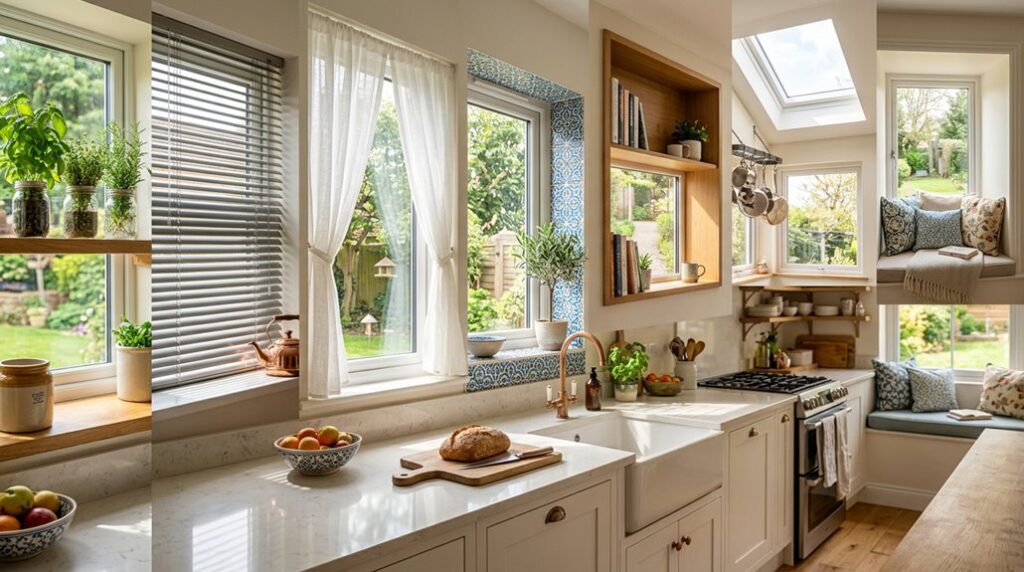
Your kitchen window deserves more than basic functionality; it’s an architectural feature that sets the tone for your entire space.
Whether you’re working with a cramped galley kitchen or an open layout, strategic window treatments and design choices can dramatically enhance natural light, create visual depth, and establish focal points.
I’ll walk you through seven proven approaches that designers consistently recommend.
The first strategy might surprise you with its simplicity.
Display Glassware on Open Shelves Above Your Window
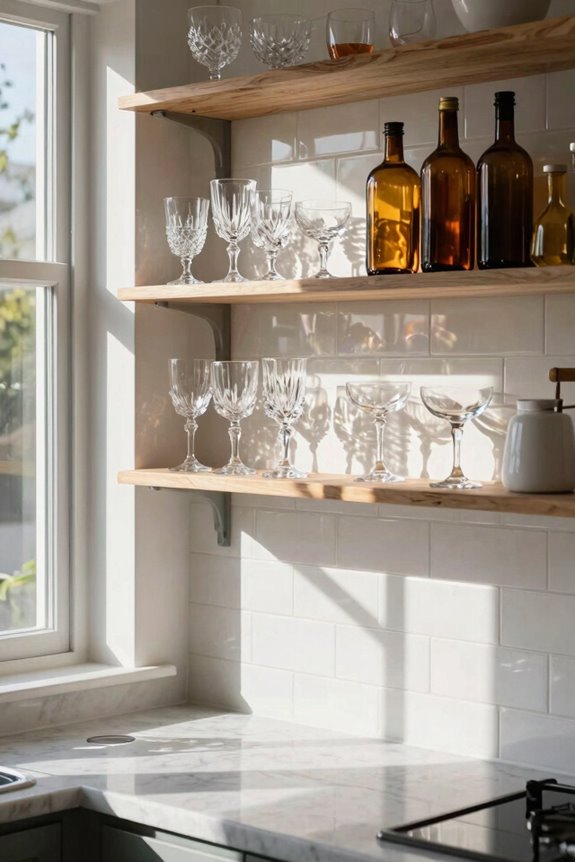
Why settle for standard window treatments when you could use open shelving above your window? Open shelving suspended above your window frame maximizes storage while creating a striking focal point. Your glassware and liquor bottles catch natural light beautifully on these shelves, eliminating the need for curtains that would obstruct views and dim interiors.
Designer Eddie Maestri of Maestri Studio popularized this butler’s pantry approach, demonstrating how floating shelves facilitate easy access to frequently used items. The natural light streaming through your window makes glass and crystal pieces sparkle, turning everyday dishware into decorative elements. This design strategy achieves dual functionality: you gain practical storage without sacrificing aesthetics or natural illumination.
This approach creates a sophisticated kitchen environment that demonstrates your design sensibility.
Add Color With Roman Shades for Kitchen Windows
How can you introduce warmth and visual intrigue to your kitchen without a complete redesign? Roman shades are window treatments that shift your space’s entire atmosphere.
Color-driven Roman shades create focal points by contrasting your kitchen’s primary palette. Make sure you select hues opposite your existing scheme for maximum visual balance. These tailored shades offer adjustable light filtration while maintaining sophistication.
Consider these applications:
- Pair jewel tones against neutral cabinetry
- Layer shades with complementary valances
- Choose patterns that echo backsplash designs
- Select fabrics with subtle texture variation
- Combine multiple treatments for depth
The kitchen window becomes a statement feature rather than an afterthought. Soft, structured folds frame views elegantly while controlling ambient light.
This approach enriches your design narrative without overwhelming the space, delivering belonging through intentional, cohesive choices.
Frame Your View in Black Trim
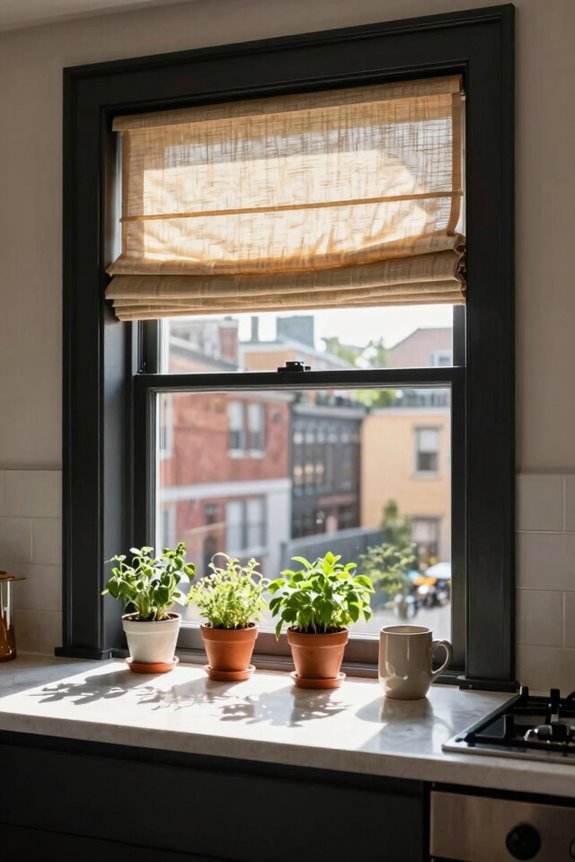
I frame your kitchen window with black trim to create a bold contrast that grounds light-filled spaces and turns the view into something akin to a photograph. This technique, championed by designer Kelly Hurliman in her all-white kitchen schemes, introduces dimensional interest through a strong accent hue that draws the eye and defines the window’s perimeter.
When you pair black-trimmed windows with light cabinetry and bright countertops, the dark boundary becomes a grounding element that enhances the entire kitchen’s modern aesthetic.
Bold Contrast Statement
When you’re seeking to enhance a kitchen’s visual hierarchy, black window trim delivers immediate architectural presence against lighter walls. This approach makes windows focal points rather than functional elements. Designer Kelly Hurliman demonstrates how black frames create dramatic layering in all-white kitchens, establishing dimensional depth that captures attention while preserving natural light and views.
The frame itself becomes a design feature rather than mere filler. Black trim works well with darker cabinetry and hardware, creating visual consistency throughout your space. This strategy suits modern, high-contrast aesthetics effectively.
Consider these implementation strategies:
- Install 2-3 inch black trim around existing window frames
- Pair with white or cream walls for maximum contrast
- Coordinate with existing dark hardware and cabinetry
- Maintain clear sightlines to exterior views
- Balance multiple windows with consistent trim width
Depth Through Dark Framing
Black window trim doesn’t just frame your view; it fundamentally reshapes how your kitchen feels spatially. Designer Kelly Hurliman demonstrates this principle by pairing black frames against all-white cabinetry, creating dimensional contrast that anchors the window openings. The darker trim draws your eye toward the view while grounding bright, airy spaces with a unified architectural frame.
Over time, black trim develops a subtle patina that adds layered depth to your kitchen’s aesthetic. This approach works particularly well in contemporary and minimal interiors, where the strong frame prevents the space from feeling flat or one-dimensional.
Choose Clear Glass for Unobstructed Views
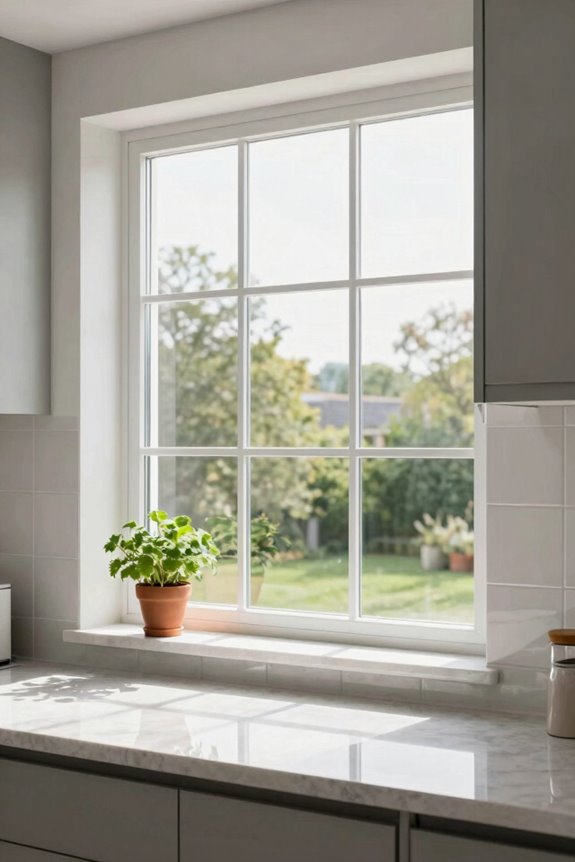
Why do so many contemporary kitchens feature expansive window panes without decorative glazing or heavy muntins? Clear glass eliminates visual barriers, creating a more open feel in your kitchen.
Clear glass eliminates visual barriers, creating a more open feel while maximizing natural light in contemporary kitchens.
When you replace leaded or frosted panes with transparent glass, you’re maximizing natural light while minimizing clutter around your sink and stove areas. This strategy works particularly well alongside dark framing; black frames or painted trim create striking contrast that emphasizes depth and architectural details beyond your window.
Consider these benefits:
- Enhances perceived space through unobstructed sightlines
- Reduces visual noise in high-traffic zones
- Allows exterior views to become focal points
- Pairs seamlessly with minimal framing approaches
- Creates modern, airy kitchen aesthetics
Clear glass paired with structured frames delivers both function and contemporary style without compromise.
Paint Window Trim Dark for Architectural Depth
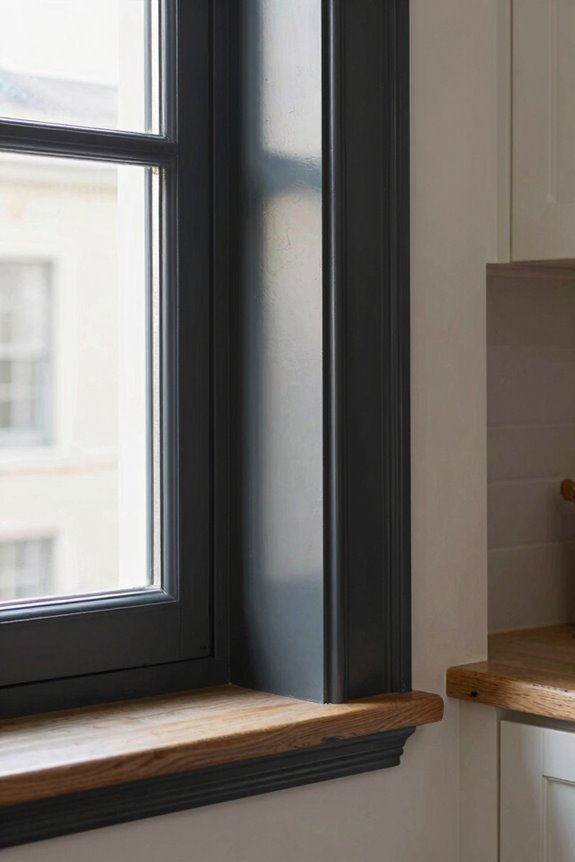
How does a simple paint choice improve your kitchen’s visual structure? Darker window trim creates architectural depth by establishing contrast against light walls, making windows function as focal points rather than afterthoughts. Designer Serena Dugan employs this technique to ground kitchens and enhance dimensional interest around openings.
Dark trim frames views and shadows effectively, contributing to a sculpted, room-defining silhouette that enhances your space’s overall composition. When selecting trim color, choose a complementary or contrasting dark hue that balances your cabinetry and counter tones.
This approach requires minimal investment. A quality paint application transforms the perception of your window’s architectural presence. The result is a layered, patinaed aesthetic that signals purposeful design throughout your kitchen.
Use Café Curtains to Balance Light and Privacy
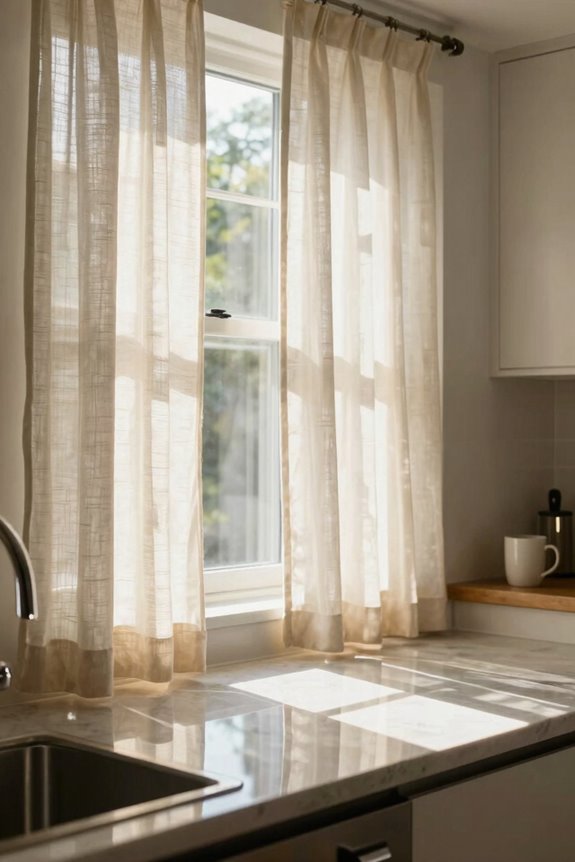
When you’re seeking a window treatment that won’t consume your kitchen’s airiness, café curtains offer a practical solution that filters natural light while establishing partial privacy at eye level. I find they work exceptionally well in high-traffic cooking zones where full-length drapes create obstruction.
These short panels coordinate without disruption with existing elements: island skirts, cabinetry finishes, or backsplash patterns, creating visual harmony throughout your workspace.
Consider these advantages:
- Maintains brightness without sacrificing sightline privacy
- Suits busy kitchens where lengthy fabrics pose safety concerns
- Delivers cottage-modern aesthetic through strategic color or pattern selection
- Allows unobstructed counter and window access
- Pairs effectively with complementary design features for unified style
The treatment preserves your kitchen’s open-air feeling while delivering functional coverage. Select linen blends or cotton twills in neutral tones for timeless appeal, or experiment with subtle geometric prints that echo your existing palette.
Install Corner Windows to Fill Awkward Spaces
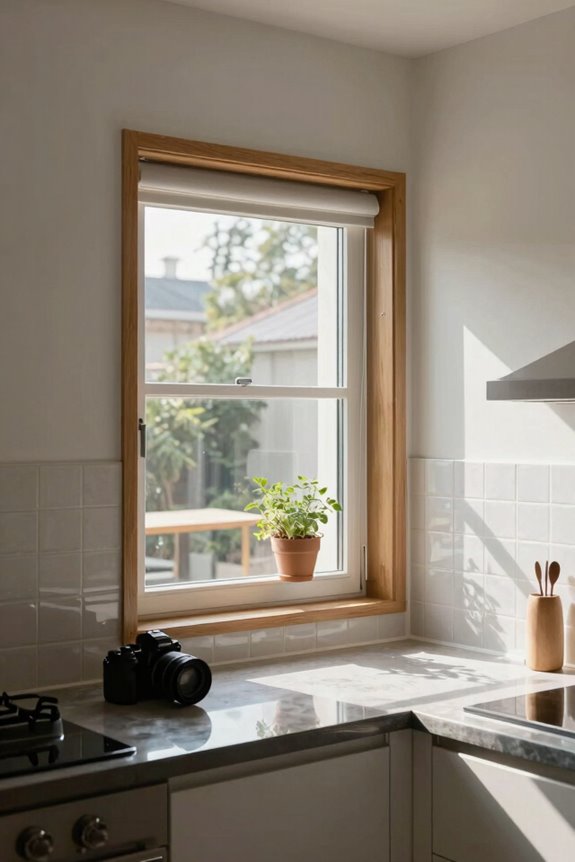
Corner windows strategically positioned around your stove area create dual light sources that brighten adjacent walls simultaneously, widening what might otherwise feel like cramped or dead space into visually open zones. Designer Lindsey Black demonstrates how this approach widens your sightlines and enhances the perceived openness of narrow kitchen layouts by allowing natural light to flood from multiple angles rather than a single wall direction.
When you install corner windows flanking your cooking zone, you’re multiplying your brightness potential while solving the fundamental design challenge of awkward wall configurations that typically resist conventional window placement.
Maximizing Light In Corners
Why do so many kitchens waste their corners? They’re dead zones, forgotten spaces that collect clutter instead of light. Corner windows change this entirely. By wrapping glazing around two perpendicular walls, you’re capturing daylight from multiple directions simultaneously. This makes those awkward areas into bright, prominent spaces.
Designer Lindsey Black demonstrates how corner installations flanking stove areas eliminate visual dead zones while enhancing light distribution throughout the kitchen. The strategy utilizes existing architecture rather than fighting it.
Consider these benefits:
- Brightens tight, cramped layouts dramatically
- Improves perceived room size through natural light
- Reduces shadow zones near work surfaces
- Enhances visibility for cooking tasks
- Converts dead corners into functional prominent spaces
Corner windows address the fundamental problem: kitchens need light from every angle, especially near seating and work zones where brightness matters most.
Addressing Narrow Wall Spaces
How do you salvage a kitchen where wall space is fragmented by doorways, appliances, and structural columns? Corner windows offer a practical solution. By flanking a stove or seating area with uniquely positioned windows, you create visual balance and brightness in the cooking zone.
Corner windows expand your kitchen’s perceived footprint without removing essential wall space. They convert tight, unusable corners into bright focal points, particularly valuable in kitchens with limited linear wall length. This approach addresses cramped layouts directly, filling awkward spaces that would otherwise feel closed-in.
The result is a brighter, more open kitchen that maximizes natural light while maintaining functional storage and counter areas.
Enhancing Kitchen Layout Flow
Strategic window placement in corner zones improves how you navigate and perceive your kitchen’s spatial flow. Designer Lindsey Black demonstrates this principle through installations that balance cooking zones with natural sightlines, creating visual continuity rather than cramped dead zones.
Corner windows accomplish this by:
- Introducing multiple outdoor view angles that expand perceived dimensions
- Positioning glazing to guide movement between work stations naturally
- Pairing enhanced window frames with strategic cabinetry placement for accessibility
- Drawing light into previously shadowed cooking areas
- Creating focal points that anchor kitchen layouts without consuming floor space
This approach works particularly well when combined with frosted or clear glazing options. The resulting geometry encourages circulation patterns while eliminating the visual weight of solid walls, establishing the kitchen as an integrated gathering space rather than isolated functional area.