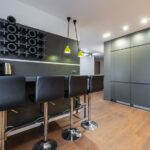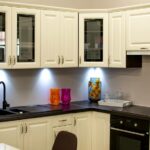
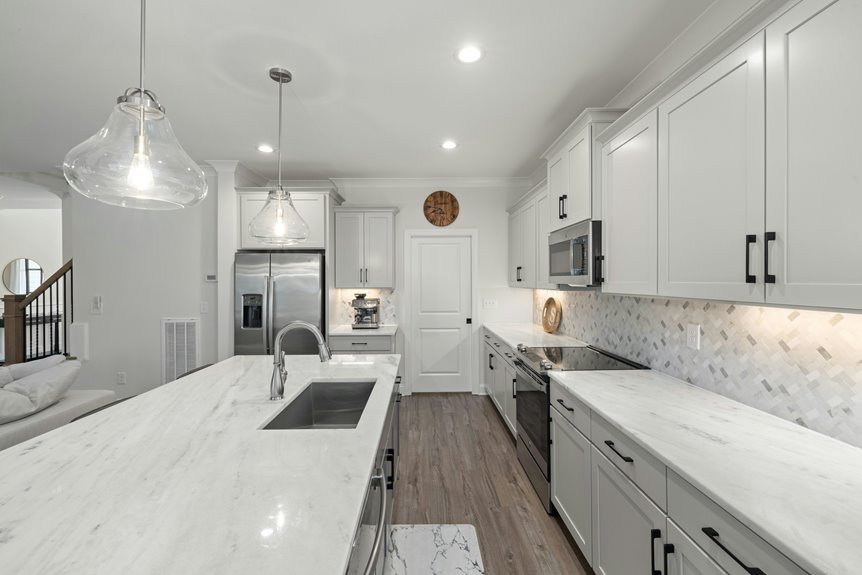
I’ve found that combining task lighting, ambient lighting, and accent lighting creates a kitchen that’s both functional and welcoming. When you pair pendant fixtures over islands with under-cabinet LEDs and a striking focal point, you’re building depth that standard overhead fixtures simply can’t provide. The right approach involves specific choices: matte black pendants with brass accents, positioned 30–36 inches above counters.
However, here’s what most homeowners miss. The real benefit comes when you understand how these layers work together, and that’s where we should focus next.
Mix Task, Ambient, and Accent Lighting for Depth
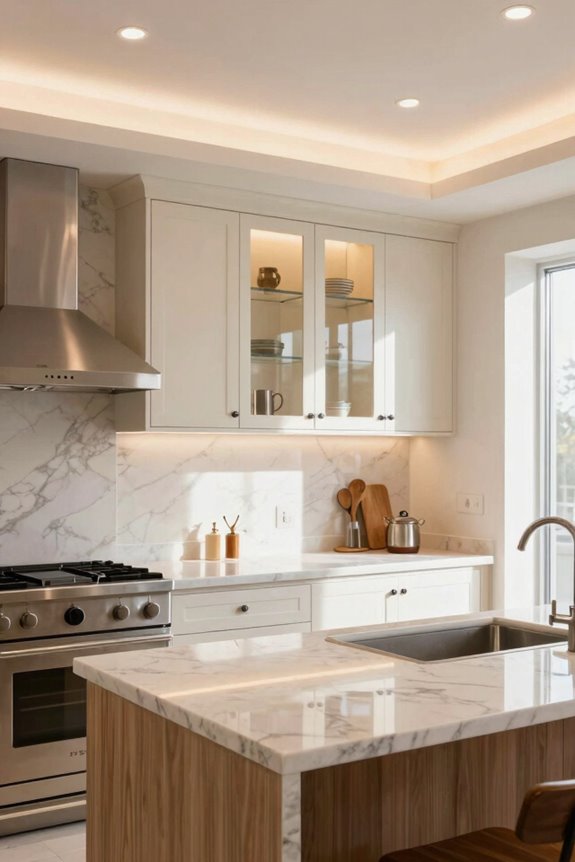
Why do so many kitchens feel flat and uninviting despite having adequate light? The answer lies in layered lighting, a strategy that combines task, ambient, and accent lighting to create depth and visual interest.
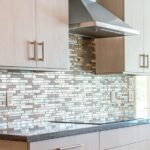
Task lighting over islands and counters illuminates work surfaces where you prep meals. Ambient lighting from overhead fixtures or sconces provides general glow throughout the space. Accent lighting highlights focal points like backsplashes or open shelving, drawing the eye to design features you’ve chosen carefully.
Independent lighting controls and dimmers let you adjust each layer separately, tailoring brightness for breakfast, dinner, or evening relaxation. This approach eliminates glare while maintaining cohesive finishes; brass accents paired with matte black and textured surfaces create a kitchen that feels both functional and intentionally designed.
Choose Pendant Shapes and Styles for Your Island
How you shape the light above your island matters as much as where you place it. Cylindrical pendants deliver modern minimalism, while globe pendants evoke mid-century charm with sleek profiles. Linear chandeliers efficiently illuminate longer islands without visual clutter.
I recommend arranging a pendant trio asymmetrically. This configuration provides reliable task illumination and creates a unified visual center that anchors your kitchen. Matte black fixtures contrast elegantly against darker cabinetry, whereas mixed metals like brass or bronze introduce visual depth alongside existing finishes.
Clear glass globes and capiz-shell pendants offer contemporary elegance with diffused light, ideal for compact spaces. Proper lighting spacing supports even surface coverage: hang pendants 30–36 inches above your counter, positioning them 24–30 inches apart. These dimensions guarantee functional task illumination across your island’s entire work surface.
Use Statement Fixtures as Design Anchors
Beyond functional task lighting, a bold chandelier or sculptural pendant serves as the visual anchor that defines your kitchen’s entire design narrative. Statement fixtures function as focal points that establish spatial hierarchy, particularly when positioned above islands or dining tables where they command attention without interrupting sightlines.
Thoughtful chandelier placement matters tremendously. In kitchens featuring high ceilings, vaulted architecture, or exposed beams, larger fixtures create visual drama that complements these architectural features. Scale and placement ensure your statement piece becomes a centerpiece rather than an overwhelming distraction.
I’ve found that pairing statement fixtures with layered ambient and task lighting maintains both mood and functionality. This combination allows your design anchor to shine while supporting practical kitchen operations. The result is a cohesive space where lighting strategy improves your entire design.
Layer Warm Metals and Natural Textures
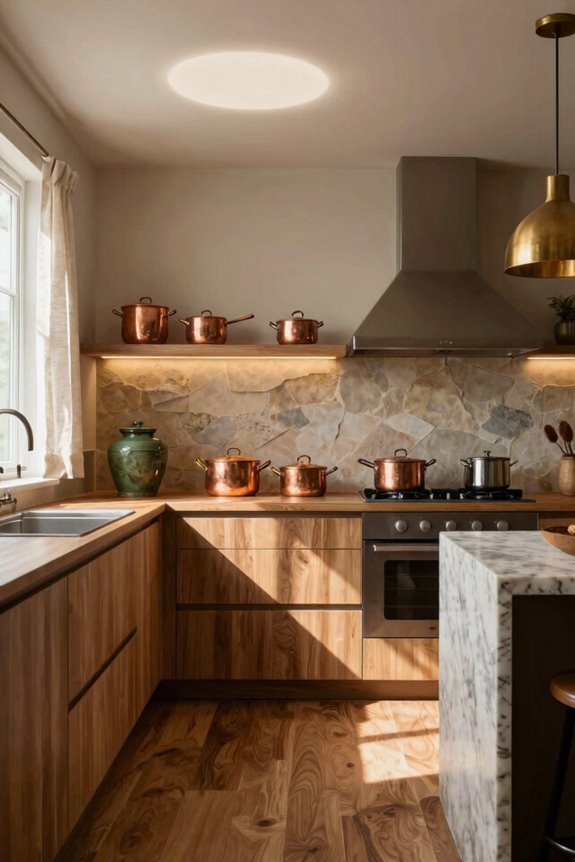
When does lighting become more than illumination? It’s when you layer warm metals and natural textures into a cohesive design strategy. I combine brass and matte black fixtures with materials like woven rattan and wood tones to create depth across ambient, task, and accent layers.
Beaded chandeliers, such as Armand pendants, introduce tactile warmth that complements wooden cabinetry beautifully. When I pair brass pendant lights over islands with linen shades, I’m balancing luminous brightness against organic contrast. The key is coordinating all metal finishes so they reflect light differently off adjacent surfaces like stone countertops. This approach keeps your layered lighting feeling purposeful rather than scattered, establishing a harmonious visual narrative throughout your kitchen.
Add Smart Lighting for Mood and Convenience
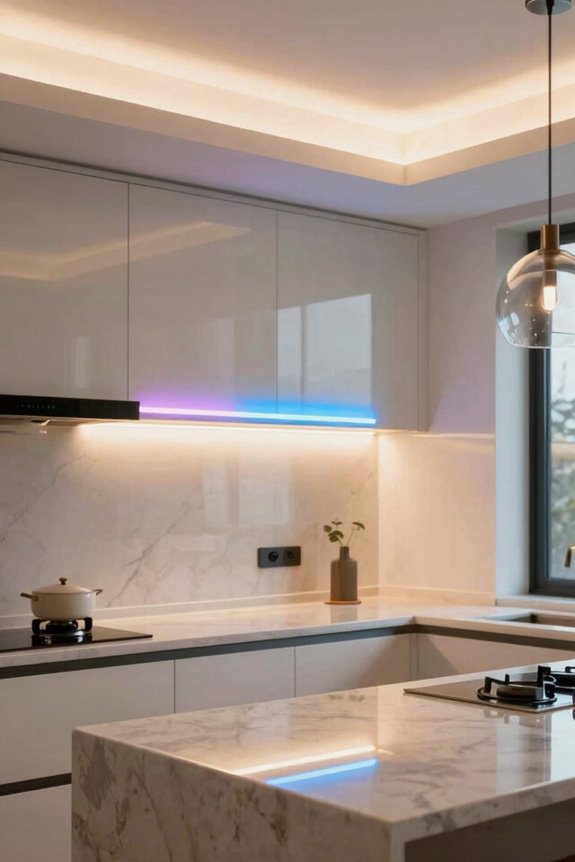
Why should your kitchen lighting remain static when technology enables it to evolve throughout your day? Smart lighting offers app-controlled dimmers and voice-controlled scene presets tailored to specific moments. I’ve found that zoned lighting, managing ambient, task, and accent layers independently, lets you activate “Dinner Time” or “Cleanup Mode” with a single command.
Tunable white technology shifts from cool morning tones to warm evening hues while maintaining practical brightness for cooking. Motion-activated strips beneath lower cabinets provide subtle safety lighting and enhance security by simulating occupancy. These schedule routines and brightness memory settings eliminate manual adjustments across multiple kitchen areas.
The result is a space that adapts to your rhythm, creating mood lighting that feels purposeful rather than arbitrary.