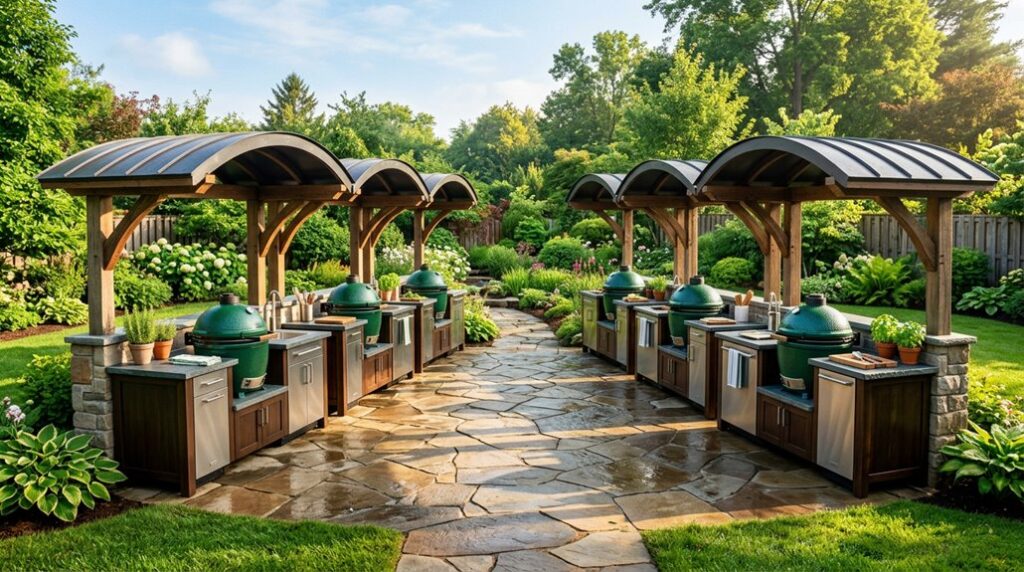
I’ll guide you through seven proven Green Egg outdoor kitchen layouts that balance form with function.
Whether you’re working with a compact yard or expansive entertaining space, you’ll find that the right setup—from simple pedestal stands to integrated island designs—changes how you cook and gather outdoors.
The key isn’t just choosing your Egg size; it’s understanding how materials, ventilation, and spatial flow work together to create something truly functional.
Let’s explore which layout fits your vision.
Choose Your Egg Size and Layout Foundation
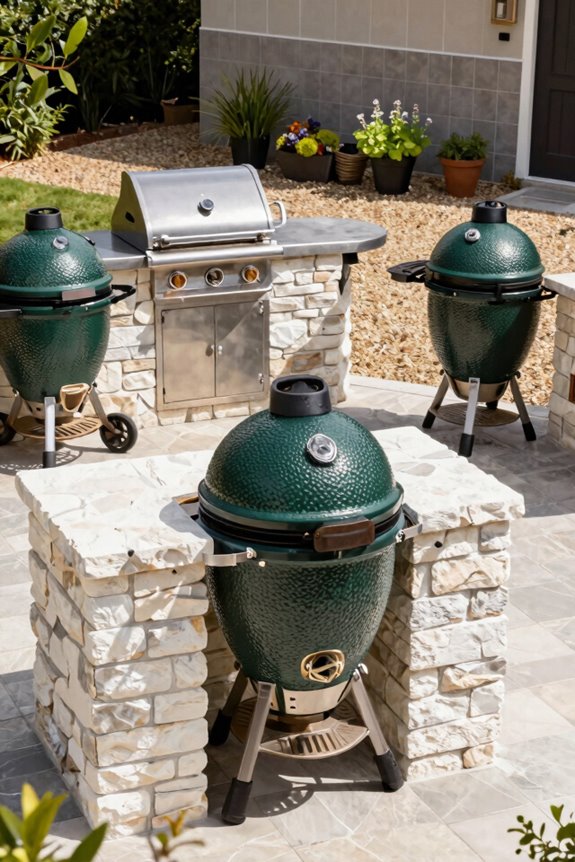
Five distinct Big Green Egg sizes form the foundation of any outdoor kitchen design, each serving different entertaining needs and spatial constraints. The 2XL (36″ grid) accommodates 12–20 guests, while the MiniMax (13″ grid) suits intimate cookouts for 1–3 people. Medium, Large, and Entertainer models fill the spectrum between these extremes.
Your layout foundation—whether a Modular Nest, Acacia Table, Modern Farmhouse Table, or IntEGGrated Nest + Handler—anchors your outdoor kitchen’s stability and storage capacity. Selecting the right Egg size and table or nest configuration determines both your cooking capacity and the footprint your space requires. This pairing creates the structural backbone of your design, influencing traffic flow and guest positioning around your outdoor kitchen.
Start here, and everything else follows logically.
Pedestal Stand: Standalone Grill Table Aesthetics
If you’re drawn to a design that showcases your Big Green Egg as both functional tool and sculptural centerpiece, a Pedestal Stand delivers exactly that balance. This configuration raises your Egg on an open-sided pedestal, creating a standalone grill table that anchors your outdoor kitchen visually. The raised design accommodates Mini through 2XL sizes, while open side panels display Big Green Egg accessories and serve prep items.
You’ll appreciate how the elevated top height positions the draft door at a comfortable working level, eliminating unnecessary bending during cooking and service. Pairing your pedestal stand with shade structures or umbrellas increases usability during extended gatherings. The result is an integrated aesthetic that treats your Egg as both essential cooking equipment and design statement within your backyard entertainment space.
Drop-In Stand: Fully Integrated Built-In Design
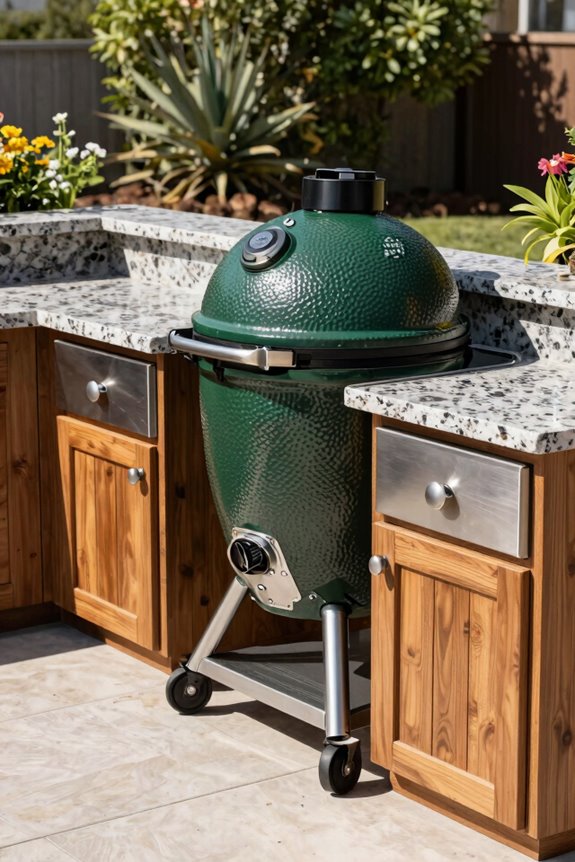
While the Pedestal Stand celebrates your Big Green Egg as a sculptural focal point, a Drop-In Stand takes the opposite approach by embedding the Egg directly into cabinetry so it becomes indistinguishable from your outdoor kitchen’s architecture. This built-in installation recesses the Egg into your island, exposing only the dome while the base sits concealed beneath the countertop.
The integrated design preserves full draft door access and creates seamless visual continuity with surrounding cabinetry. Professional installation ensures precise cutouts that accommodate proper appliance access and ventilation requirements. Confirm compatibility with your Egg size beforehand, particularly for XL models.
When executed correctly, the drop-in stand delivers a sophisticated, unified aesthetic that turns your backyard into a polished outdoor living space.
Recessed Stand: Accessible Storage With Front Access
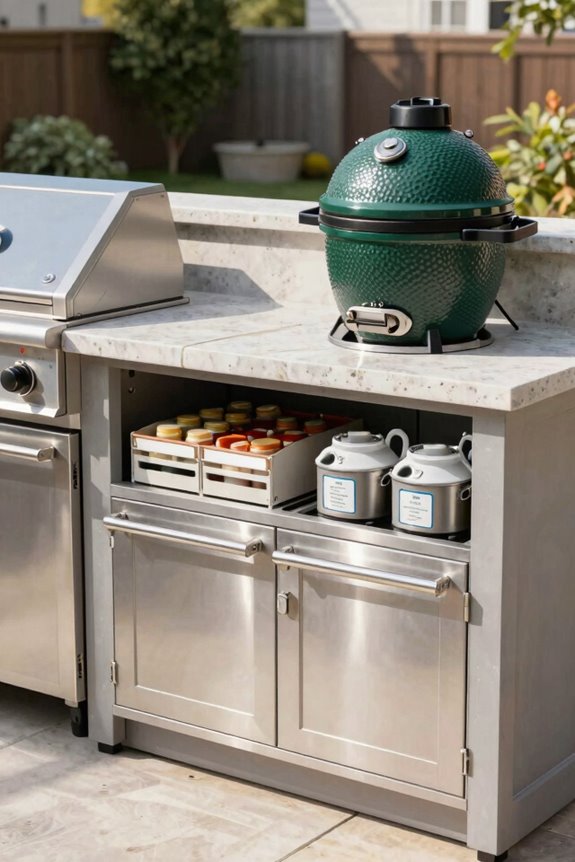
A recessed stand embeds the Big Green Egg into a hollowed cavity with a front-facing opening, delivering an integrated look while keeping your workflow unobstructed and accessible. The metal sleeve option, an interior blanket that lines the recessed cavity, pairs with a pull-out accessory drawer to create organized storage without sacrificing the built-in appearance.
You’ll want to confirm your Egg size fits the cavity, as Large models max out the typical compatibility range and XL or 2XL configurations simply won’t work in this setup. This approach works well when you anchor surrounding cabinetry and prep stations around the recessed footprint, creating a cohesive outdoor kitchen zone with purposeful design.
Storage And Design Integration
How do you maximize both functionality and aesthetics in a compact outdoor kitchen? A recessed stand integrates your Big Green Egg effortlessly into an island structure, creating a built-in appearance that enhances your space visually. The front-access design positions the Egg within a hollowed cavity, allowing full operational access without protruding edges that interrupt your countertop flow.
Optional metal sleeves enhance this integration further, wrapping the interior while a storage drawer beneath provides convenient access to cooking tools and accessories. This configuration typically accommodates Large Eggs comfortably, though XL or 2XL models may not fit reliably. The result combines efficient draft door access, maintenance capability from the exterior, and unified design that turns your backyard into a polished entertaining destination.
Installation And Size Considerations
Why does sizing matter so critically when you’re planning a recessed stand installation? Because a recessed stand places your Big Green Egg inside a hollowed island with front access to the draft door, and space constraints determine what you can accommodate.
I’ve found that Large Eggs typically fit comfortably within this configuration, while XL or 2XL models generally won’t work due to dimensional limitations. The recessed stand creates a built-in island appearance with optional metal sleeves that add interior storage and a convenient drawer. This front-access workflow keeps your cooking zone organized and efficient.
Before committing to this layout, confirm compatibility and installation details with your dealer. They’ll verify proper fit for your chosen Egg size, preventing costly modifications later.
Island and L-Shaped Layouts
When you’re envisioning a centerpiece for your backyard cooking space, island and L-shaped configurations offer distinct advantages that’ll improve both functionality and aesthetics. I find that pedestal-based island setups create that coveted Big Green Egg table look, with open sides accommodating everything from Mini to 2XL models. Drop-in stands embed your Egg into the island while maintaining full draft door access and a completely exposed top for grilling visibility.
L-shaped configurations take efficiency further. They support two independent cook stations simultaneously, generating 128 inches of total length. You’ll gain generous prep space between cooking zones. Recessed stands hollow the island front, integrating a metal sleeve and storage drawer for a sleek, space-efficient design.
Each layout option delivers built-in sophistication while preserving practical accessibility, whether you’re searing proteins or managing multiple cooking tasks alongside fellow enthusiasts.
Material Choices for Durability and Style
What you’ll build your outdoor kitchen from matters as much as its layout. Material selection determines whether your investment weathers years of use or deteriorates within seasons.
For your Big Green Egg outdoor kitchen, I recommend concrete, steel, or natural stone as base materials. Concrete offers sleek durability and weather resistance with minimal maintenance. Steel and aluminum provide modern aesthetics without upkeep demands. Stone countertops deliver elegance while withstanding moisture exposure effectively.
Marine plywood with waterproof membranes works as a budget-friendly option. Weather-resistant finishes protect all materials from seasonal temperature swings and precipitation. Your material choices directly influence longevity, practicality, and outdoor durability.
Coordinating finishes with your overall design maintains visual harmony while prioritizing protection. This creates a space where you’ll confidently gather for years ahead.
From Plans to Build: Installation Steps
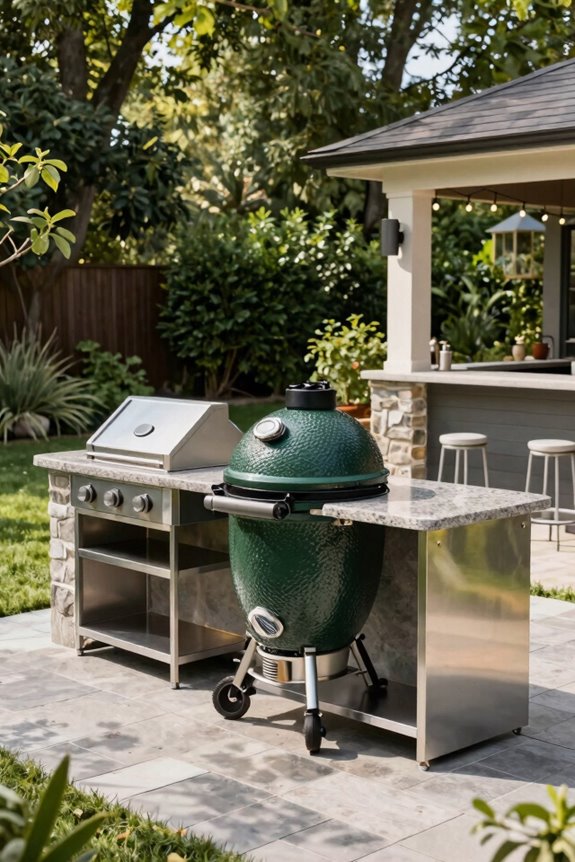
How you transition from concept to completed outdoor kitchen determines whether your Big Green Egg installation functions smoothly or encounters costly complications down the line. I recommend starting with site preparation and leveling, then building your frame using pressure-treated wood or metal studs.
Cover the frame with cement board, apply a scratch coat, and finish with your chosen cladding: stone, tile, or stucco. Next, you’ll integrate your Big Green Egg using a pedestal, drop-in, or recessed stand based on your desired aesthetic.
Position it to allow clear front airflow and adequate space behind the lid for heat and regulator access. Finally, install your outdoor-rated countertop materials and hardware, making sure proper ventilation or extraction is in place. Access free email support from designers throughout your installation for layout and appliance guidance.