I’ve found that linoleum works beautifully in kitchens, linoleum protects budgets, and linoleum endures daily wear better than most homeowners expect. You’re probably familiar with linoleum’s reputation for being basic or dated, but modern manufacturers like Forbo and Armstrong have completely reimagined what’s possible with this material.
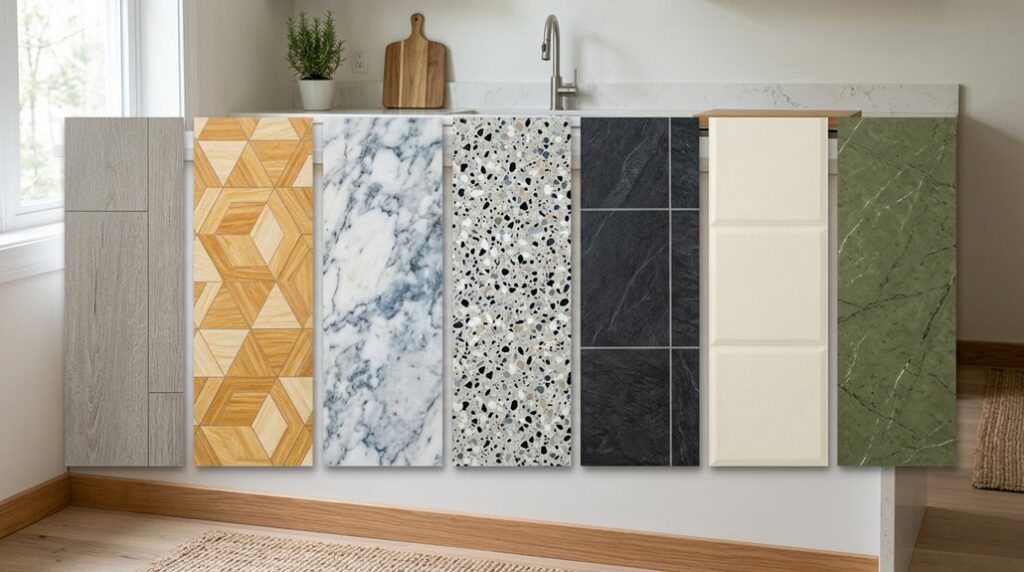
From striking checkerboards to sophisticated marble effects, today’s options deliver designer-level aesthetics without the designer price tag. Here’s what makes these seven approaches worth your consideration.
Bold Black and White Checkerboard for Timeless Contrast
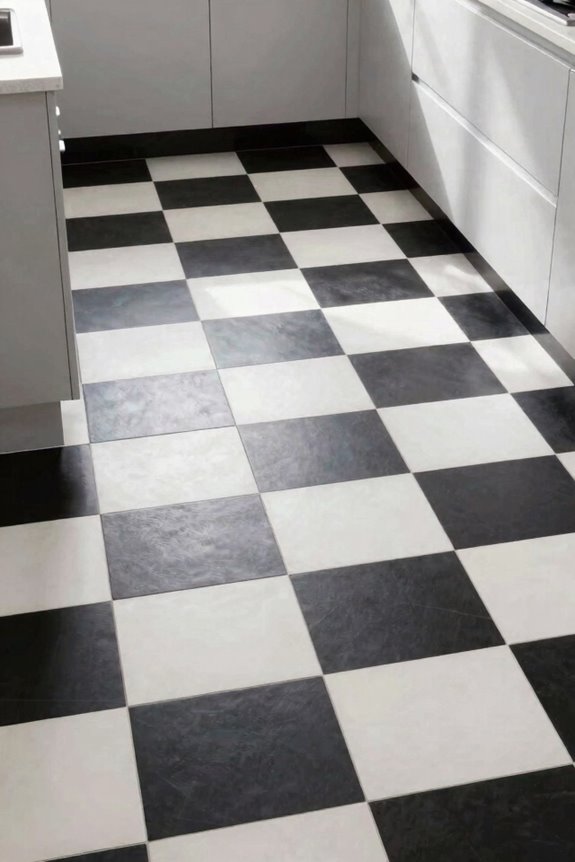
Why does the checkerboard pattern endure across design eras? It’s because bold black and white contrast creates visual impact that transcends trends. I’ve found that this timeless aesthetic works beautifully in modern kitchens, pairing seamlessly with both minimalist and retro décor styles.
Linoleum and Marmoleum offer practical advantages for achieving this look. You can execute checkerboard patterns using standard tile sizes, such as 50×50 cm or 100×25 cm tiles, to achieve crisp, high-contrast layouts. What makes linoleum exceptional is that its colors run throughout the material itself, meaning scratches reveal consistent design rather than exposing worn surfaces.
Installation becomes straightforward with large-format sheets or modular tiles enabling seamless checkerboard runs. Marmoleum even provides adhesive-free options that reduce installation odors. Designers like Beata Heuman and Bridie Hall have leveraged red-and-white or black-and-white checked linoleum to create bold, graphic kitchen statements.
Marbled Linoleum for Subtle Sophistication
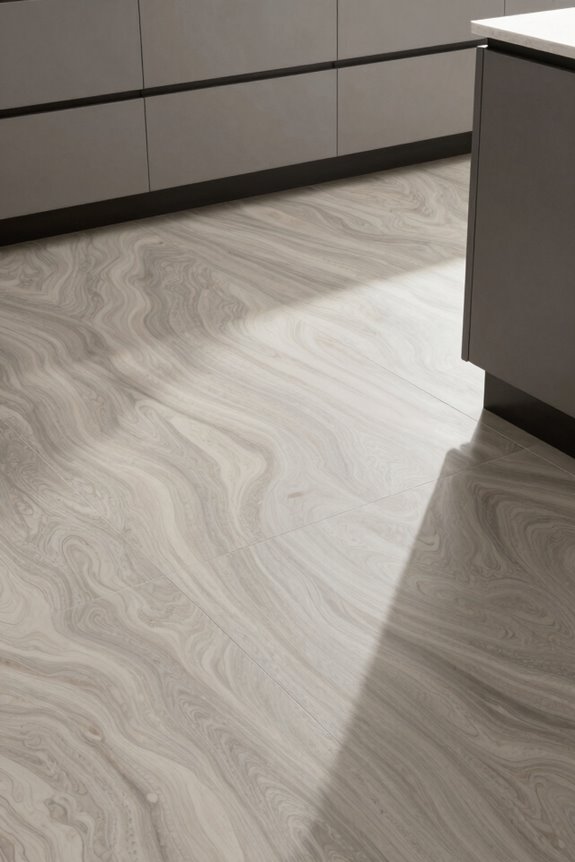
While bold checkerboard patterns command attention through high contrast, marbled linoleum achieves sophistication through understated complexity. I find that embedding variegated tones throughout the material creates depth that runs the full sheet or plank, offering what Forbo’s Marmoleum line demonstrates beautifully in modern kitchens.
The marbled effect pairs strategically with neutral cabinetry and minimal hardware, letting your kitchen floor become the design feature. Because linoleum contains natural components like linseed oil and cork, these patterns maintain consistent color variation over time without fading unevenly.
You’ll appreciate the installation flexibility too. Whether you choose sheet goods for glue-down application or modular tiles for floating-floor options, marbled linoleum adapts to your kitchen’s needs. Some configurations even eliminate adhesive requirements, reducing installation odor considerably.
Warm Earthy Neutrals That Complement Any Cabinetry
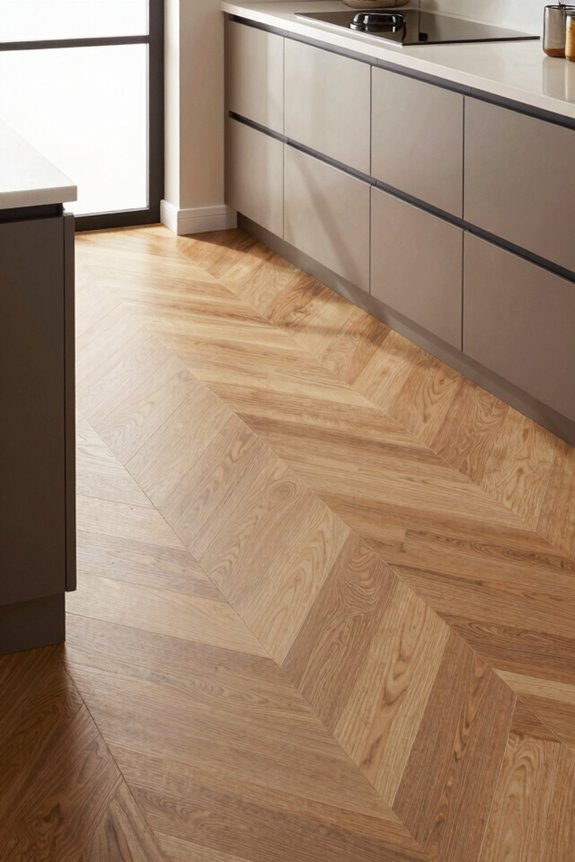
I’ll guide you through selecting warm earthy neutrals that work seamlessly with your existing cabinetry, whether you’re drawn to natural wood finishes or contemporary painted tones. Linoleum’s color-through construction in beige, taupe, and warm grey shades means scratches won’t reveal contrasting layers, a practical advantage in high-traffic kitchens where durability matters.
Forbo Marmoleum and standard linoleum both deliver these neutral palettes in sheet, plank, and tile formats with low-gloss matte finishes that conceal dust while maintaining the timeless warmth modern kitchens demand.
Natural Color Palette Selection
When you’re selecting linoleum for your kitchen, warm earthy neutrals like taupe, sand, and caramel offer more than aesthetic appeal. They’re engineered to maintain their appearance through daily wear. I’ve found that Marmoleum’s natural color palette selection works exceptionally well for modern kitchens because the pigments run throughout the material itself.
Consider these advantages:
- Colors remain consistent even when scratched or scuffed
- All-natural composition (linseed oil, cork, wood flour, mineral pigments) pairs seamlessly with wood cabinetry
- Matte finish resists showing dust in high-traffic zones
- Warm neutrals accommodate evolving accent colors over time
- Sheet or plank formats create low-contrast, seamless backdrops
This approach helps your linoleum flooring complement both current design schemes and future style shifts without replacement.
Design Versatility With Cabinets
Your kitchen cabinetry serves as the anchor for the entire space, and linoleum’s warm earthy neutrals—from soft cream to deep taupe—create a foundation that works with nearly any cabinet style without competing for visual attention. This versatility stems from linoleum’s consistent color throughout the material; scratches reveal the same warm tones rather than contrasting underlayers that compromise aesthetics.
Forbo Marmoleum delivers factory-stable options ideal for high-traffic areas paired with natural wood or beige cabinetry. Consider checkerboard or marbled patterns in earth tones to echo cabinet wood grain while adding visual interest. The material’s broad color blocks enable coordination across the spectrum, whether your cabinets lean light or deep.
Linoleum’s hypoallergenic composition reinforces this unified aesthetic, establishing a kitchen where flooring and cabinetry feel intentionally designed rather than mismatched.
Color-Blocked Linoleum to Define Kitchen Zones
How can a single flooring material create visual separation without jarring transitions? Color-blocked linoleum accomplishes exactly this by dividing your kitchen into functional zones while maintaining visual harmony. I recommend considering these strategic approaches:
Color-blocked linoleum divides your kitchen into functional zones while maintaining visual harmony through a single, cohesive flooring material.
- Use warm neutrals in cooking areas and contrasting hues for prep zones
- Apply checkerboard or bold geometric patterns with Marmoleum for durable, through-color pigmentation
- Combine planks and tiles to delineate adjacent areas with varying block sizes
- Leverage the material’s durability to hide dirt and wear in high-traffic spaces
- Extend your color story through matching cabinetry or backsplashes
Because linoleum’s color runs throughout the material, scratches remain inconspicuous. This creates defined kitchen zones without introducing multiple flooring transitions, resulting in a professionally organized space that feels purposefully designed rather than fragmented.
Geometric Patterns for Retro and Contemporary Flair
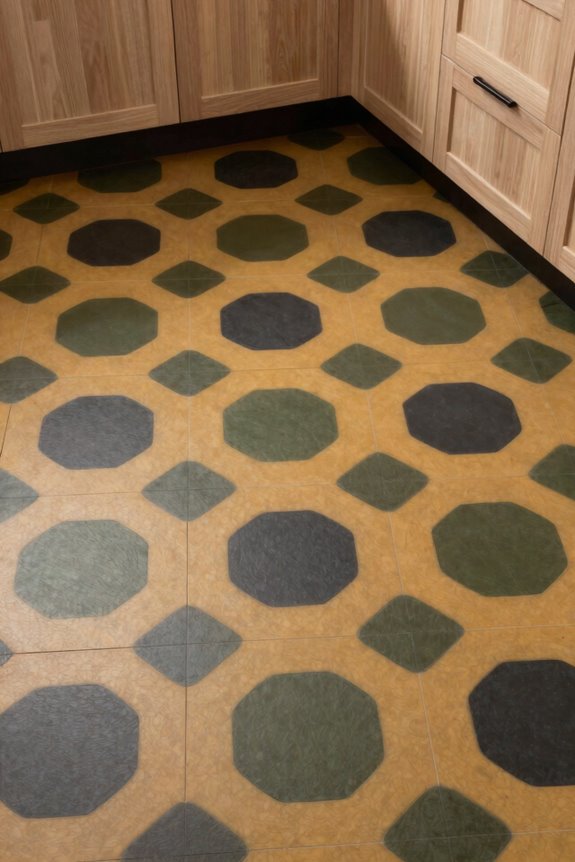
Geometric linoleum patterns, including checkerboards, color blocks, and bold linear designs, serve as visual anchors that ground a kitchen’s aesthetic while accommodating both retro and modern sensibilities. I’ve found that classic black-and-white checkerboards transcend era boundaries, pairing seamlessly with vintage or minimalist approaches.
For contemporary spaces, designers favor high-contrast patterns like red-and-white combinations that define visual flow in open-plan kitchens. Marmoleum by Forbo excels here; its colors run throughout the material, ensuring consistent appearance despite scratches, and it supports installation without adhesive, which is important for kitchens experiencing heavy traffic.
Large-format modular tiles in square or rectangular shapes enable precise geometric layouts that accent borders or focal points. These linoleum solutions create modern kitchens with purposeful, well-considered design where pattern functions as meaningful architecture.
Extend Linoleum Into Hallways for Cohesive Flow
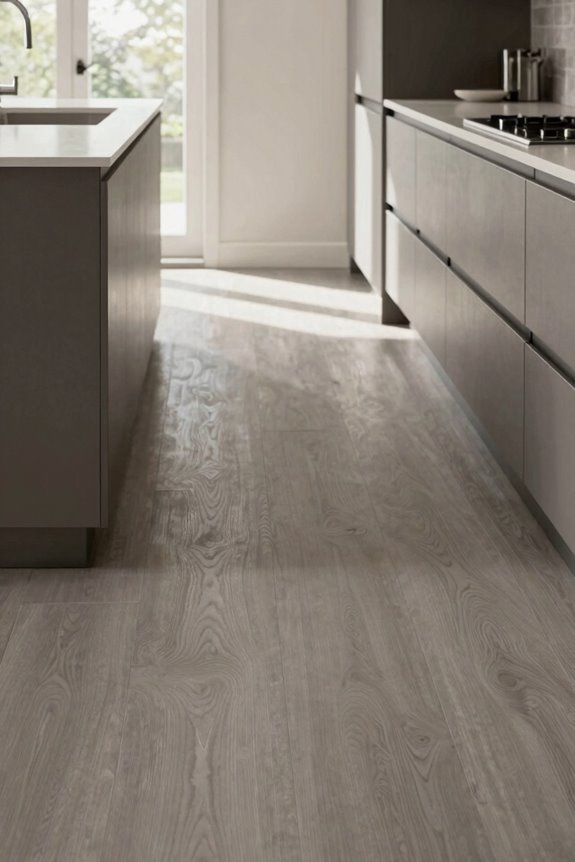
I’ll extend your linoleum from the kitchen into hallways to create visual continuity and practical installation benefits. When you run the same linoleum, whether Marmoleum or a coated sheet product, across both spaces, you eliminate jarring transitions and make both areas feel larger and more unified.
This smoothly integrated approach also simplifies maintenance since continuous flooring reduces grout lines and cleaning hotspots. Linoleum’s color-through composition means hallway scuffs blend naturally rather than revealing a contrasting substrate.
Creating Visual Continuity
One of the most effective ways to expand your kitchen’s visual impact is extending linoleum flooring into adjoining hallways, which creates a fluid connection that makes your home feel larger and more deliberately designed.
Visual continuity through consistent flooring transitions strengthens your home’s design narrative. Consider these strategies:
- Match colorways across kitchen and hallway linoleum to reinforce spatial unity
- Select complementary patterns that echo without repeating, maintaining visual interest
- Use plank formats for continuous directional flow through connected spaces
- Leverage through-body color in Marmoleum to minimize visible wear patterns
- Install without adhesive where applicable, creating cleaner transition lines
This unified approach to flooring transitions makes rooms feel deliberately connected rather than compartmentalized. When your kitchen’s linoleum extends seamlessly into hallways, you’re signaling thoughtful design choices that belong in modern homes.
Practical Installation Benefits
Beyond the visual harmony that unified flooring creates, extending linoleum into hallways delivers concrete functional advantages that justify the design choice. A glued-down sheet or tile installation guarantees stable transitions between rooms, eliminating movement gaps at doorway thresholds that compromise both safety and appearance.
Because linoleum colors run through the material itself, scratches or scuffs in high-traffic hallways remain less noticeable, preserving that unified look longer. Using the same Marmoleum or linoleum line throughout adjacent spaces simplifies your maintenance routine considerably, as cleaning products and protective coatings apply uniformly across all connected areas.
Wide-format tiles or continuous plank patterns emphasize linear corridor flow while mirroring your kitchen design. This unified installation approach makes your home’s circulation zones feel like a carefully planned progression with attention to detail.
Why Linoleum Outlasts Daily Kitchen Wear
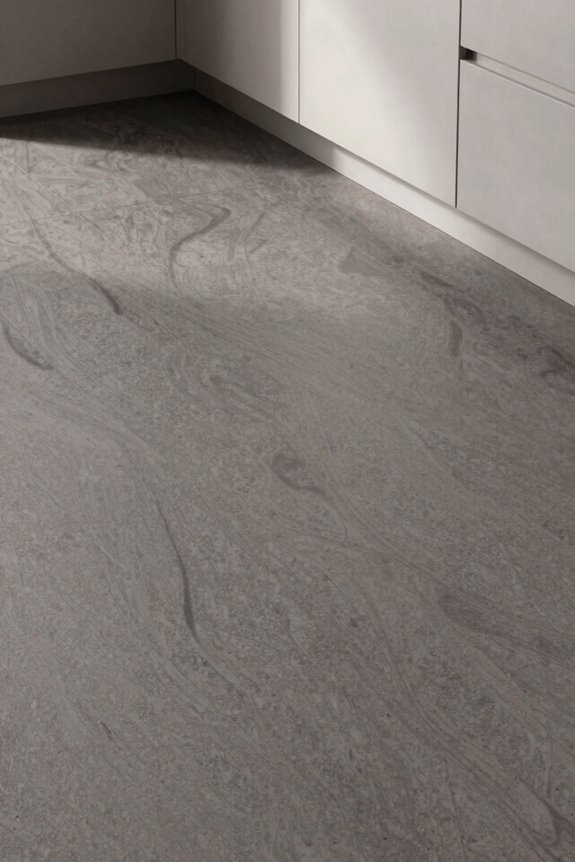
What makes linoleum resilient enough to withstand years of kitchen activity? The answer lies in its construction and inherent properties that we’ve come to trust in demanding spaces.
I’ve found that linoleum durability stems from several key advantages:
- Color and pattern penetration runs throughout the material, preventing visible wear patterns
- Antibacterial properties naturally inhibit growth without chemical treatments
- Water resistance handles spills and moisture without warping or swelling
- Impact tolerance resists scratches and minor chips better than laminate alternatives
- Repairability allows surface damage restoration, extending floor lifespan
With proper maintenance, your linoleum investment delivers long-term cost efficiency. Heat, moisture, and foot traffic won’t compromise its integrity.
Minor chips fill easily, restoring appearance without full replacement. This durability makes linoleum practical for kitchens where families gather daily, so your flooring investment performs reliably for decades.