
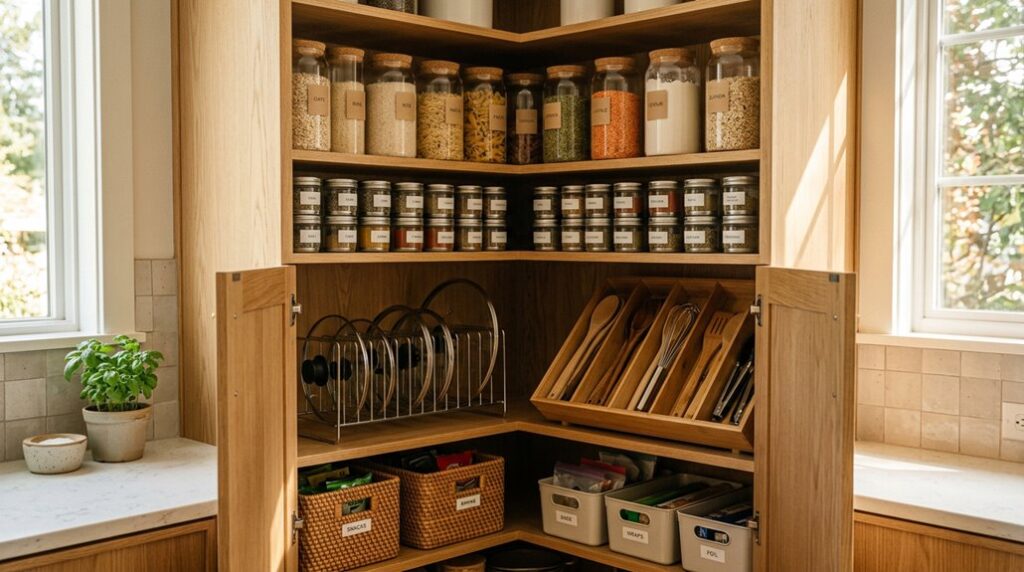
Like a puzzle with missing pieces, your kitchen’s corner cabinet sits there, accessible yet somehow inaccessible. I’ll walk you through why these spaces frustrate so many homeowners and, more importantly, how you’ll make yours into a functional storage zone.
The difference between wasted dead space and organized efficiency hinges on understanding your cabinet’s specific layout and choosing the right organizational system. Let’s explore what actually works.
Why Corner Cabinets Are Hard to Organize
Why do corner cabinets seem to swallow items whole? The awkward L-shaped layout creates a blind corner where items vanish into deep, unreachable recesses. Standard fixed shelves trap belongings behind front rows, making retrieval frustrating and time-consuming. You’ll find yourself digging through layers just to locate what you need.
Professional designers at CliqStudios recognize this universal challenge. Without specialized solutions, a corner cabinet becomes a storage black hole. Innovative mechanisms like rotating shelves and Lazy Susan systems work well for blind corners by making them more functional. These rotating trays bring items forward with minimal effort, while adjustable shelves accommodate varying heights.
The difference between a poorly organized corner cabinet and one equipped with practical storage organization is substantial. It’s the distinction between chaos and accessibility.
Pick a Purpose First: What Will Your Corner Cabinet Hold?
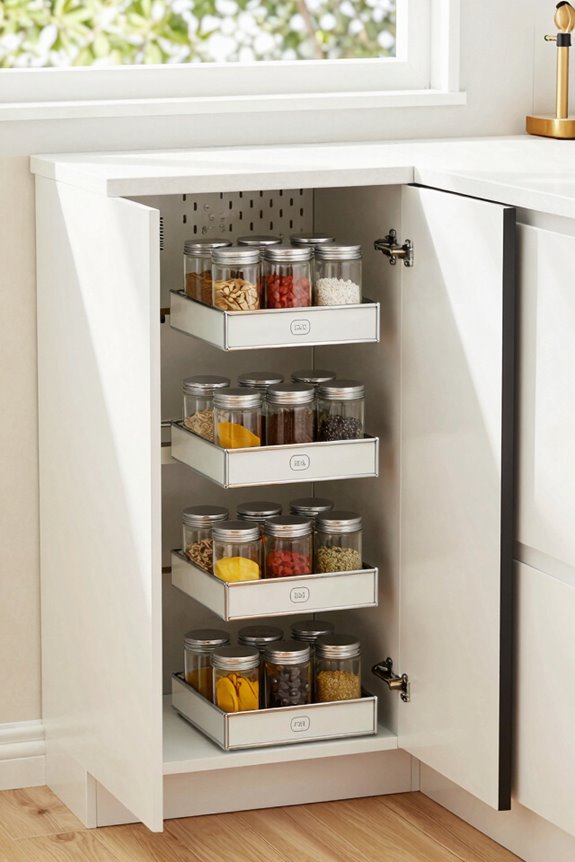
What’ll you actually store in that corner cabinet? Your answer determines everything. I recommend selecting a specific category—baking supplies, cookware, or pantry staples—before purchasing any organizational tools. This deliberate choice establishes your corner cabinet purpose and prevents the space from becoming a catch-all for miscellaneous items.
Decide your corner cabinet’s purpose first—baking supplies, cookware, or pantry staples—before buying organizational tools.
Once you’ve decided, choose storage solutions that match your category. A lazy Susan works beautifully for spice jars and small containers, while pull-out shelves maximize accessibility for heavier cookware. Tiered systems improve pantry items by increasing visibility.
Keep your collection trimmed to essentials within your chosen category. Overfilling defeats the purpose of organized storage.
Periodically reassess whether your cabinet’s contents still serve your kitchen’s evolving needs, redeclaring its purpose as necessary.
Pull Everything Out, Declutter, and Clean From Scratch
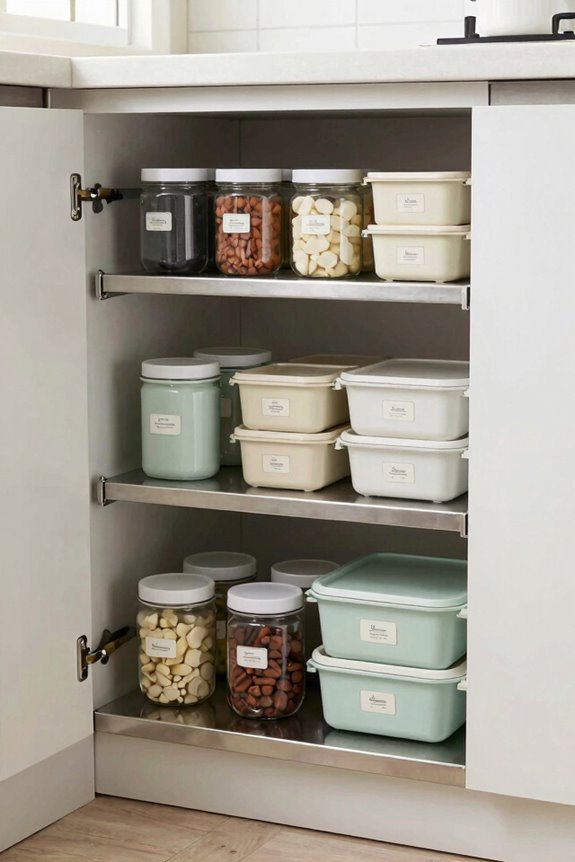
Now that you’ve identified your corner cabinet’s purpose, it’s time to tackle the foundation of your organization system: emptying the space completely. Pull everything out and group similar items together (spices, cookware, lids) so you can assess what you actually have. This complete surface view reveals broken, expired, or unused pieces that deserve donation or resale.
| Category | Action | Benefit |
|---|---|---|
| Expired Items | Remove | Safety |
| Unused Pieces | Donate | Space |
| Duplicates | Resell | Funds |
| Broken Goods | Discard | Function |
| Keepers | Retain | Purpose |
After decluttering, clean the shelves with a damp cloth and appropriate cleaner, removing dust and residue. This clean-from-scratch approach establishes solid organization foundations for your corner cabinets, allowing every returning item to earn its placement through genuine utility and accessibility.
Measure Your Corner Cabinet and Choose the Right Storage System
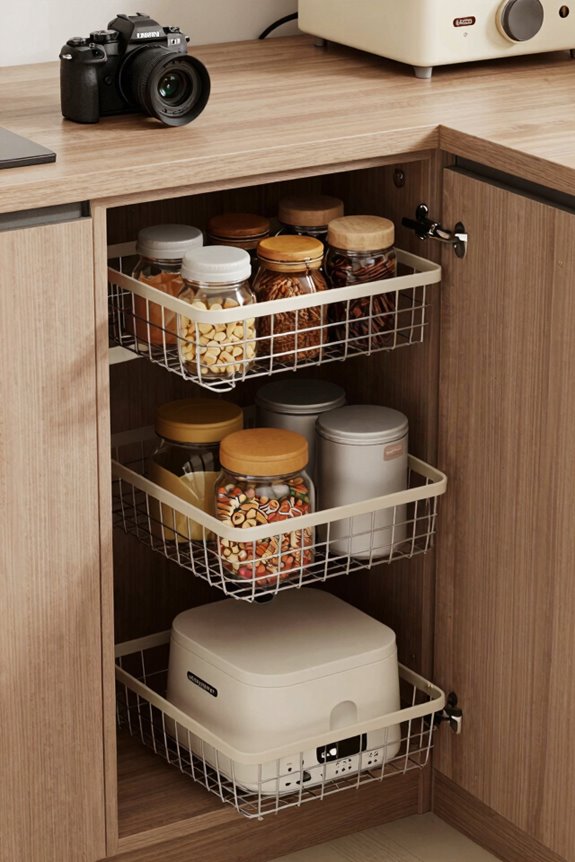
I’ll measure my corner cabinet’s width, depth, and height before selecting a storage system, since accurate dimensions determine whether a Lazy Susan, bi-fold door cabinet, or wall easy reach unit fits properly.
My measurements guide whether I need CliqStudios’ Lazy Super Susans with independently spinning pie-shaped trays or a simpler adjustable-shelf solution with one to three tiers. Once I understand my space’s exact configuration, I can match it to the right organizer, whether that’s a rotating half-moon shelf system or bi-fold doors that open approximately 170 degrees for maximum accessibility.
Accurate Measurements Matter
How can you confidently select corner cabinet organizers that’ll actually fit and function as intended? Accurate measurements create an efficient storage solution in your base cabinet. I recommend documenting these four key dimensions:
- Cabinet depth from front to back wall
- Shelf width between side panels
- Total interior height from floor to top
- Distance from hinges to opposite corner edge
These measurements prevent pull-out shelves, lazy Susans, and tiered systems from interfering with doors or creating dead space. When you measure your corner cabinet precisely, you’ll visualize how bulky items and lids fit within weight-rated hardware limits.
This data-driven approach eliminates guesswork, preventing costly returns and helping your chosen organizers maximize accessibility while supporting everything safely.
System Selection Strategies
Your corner cabinet’s layout fundamentally determines which storage systems will actually work, so understanding blind corner configurations comes before you browse organizers. I consider three important factors when selecting corner cabinet storage: material durability, accessibility range, and kitchen layouts specific to my space.
| System Type | Best For |
|---|---|
| Lazy Susans | Deep cabinets needing 360-degree access |
| Bi-fold doors | Quick retrieval in standard corners |
| Adjustable shelves | Variable-height storage needs |
CliqStudios recommends hardwood shelves with pie-shaped trays over outdated pole designs. I verify cabinet depth and width before purchasing corner cabinet organizers.
Adjustable shelves provide one to three levels depending on height, optimizing accessibility. Material selection, whether hardwood or plastic, affects longevity. You’ll find success matching organizer type to your specific blind corner layout and kitchen dimensions.
Lazy Susans vs. Pull-Out Shelves for Corner Cabinets
When you’re weighing Lazy Susans against pull-out shelves for your corner cabinet, the fundamental difference comes down to how you access items: Lazy Susans rotate items toward you in a circular motion, while pull-out shelves slide linearly like drawers. Each method delivers distinct advantages depending on your kitchen’s layout and your storage priorities.
A rotating Lazy Susan—whether kidney, pie-shaped, or full-round—maximizes your sightline of back items without requiring you to reach deep into blind spaces. Pull-out shelves give you full visibility of the entire shelf’s contents at once and typically hold more weight capacity. Your choice hinges on whether you prioritize rotational access for frequently used dry goods and canned items, or sliding accessibility paired with greater load-bearing capability for heavier cookware and mixing bowls.
Rotation Versus Sliding Access
Why do some kitchens rely on spinning trays while others favor sliding mechanisms for corner storage?
I’ve found that your choice between a Lazy Susan and pull-out shelves depends on specific needs. Rotating trays excel when you want 360-degree access without reaching deep into recesses. Pull-out shelves, however, provide linear visibility and work better for shallow cabinets.
Consider these factors:
- Cabinet depth determines whether rotation or sliding suits your space
- Item size influences stability; rotating trays pair well with two fixed shelves
- Bi-fold doors offer 170-degree access, rivaling traditional Lazy Susan convenience
- Visibility varies: rotation maximizes sight lines while slides emphasize organized rows
Modern corner cabinet optimization often combines both solutions. Pairing rotating trays with fixed shelves creates stability while enabling larger items to spin into view.
Your kitchen’s layout ultimately dictates which mechanism serves you best.
Space Utilization and Capacity
How you maximize a corner cabinet’s storage potential hinges on understanding the distinct spatial advantages each mechanism offers. Lazy Susans with rotating trays deliver superior space utilization by eliminating wasted dead zones. CliqStudios’ design removes the traditional pole-shaft mechanism, allowing independent rotation on dual hardwood shelves. You’ll gain immediate accessibility to items stored deeper within the cabinet.
Pairing top trays for bread and canned goods with bottom trays for dry pasta creates strategic storage optimization. Bi-fold gull-wing doors opening 170 degrees further enhance corner cabinet functionality. Pull-out shelves offer linear efficiency but sacrifice rotational advantage. For pantry organization, combining one to three adjustable shelves with rotating trays maximizes both capacity and usable space, converting previously inaccessible recesses into functional storage zones.
Organize Your Corner Cabinet With Clear Bins and Tiered Racks
Clearly plastic bins and tiered shelving systems work well for corner cabinets, turning them from awkward dead zones into highly functional storage. Transparent containers let you identify contents instantly without opening each bin, saving time during meal prep.
Here’s my approach to maximizing your corner cabinet:
- Install tiered racks to create multiple levels, enabling access to both front and back items effortlessly
- Select wedge-shaped bins that fit snugly within shelves, preventing shifting in tight layouts
- Label bin fronts clearly for quick identification as contents change seasonally
- Position frequently used items on upper tiers and heavier, less-used items toward the back
This organization system establishes accessibility while maintaining stability. Vertical space utilization becomes intuitive when you combine clear bins with tiered racks. Your corner cabinet becomes an organized, member-friendly storage solution.
Light, Label, and Maintain Your System
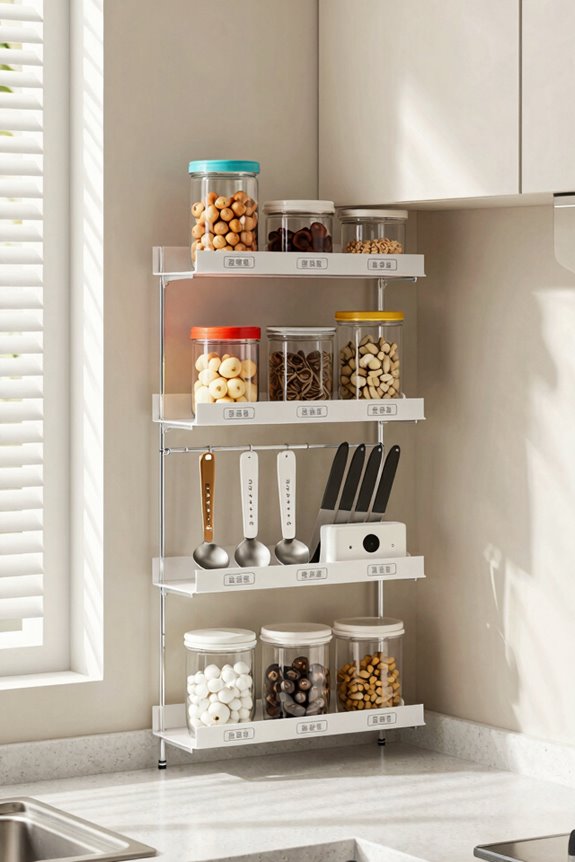
Even the most thoughtfully organized corner cabinet loses its effectiveness without proper visibility and upkeep. I recommend battery-powered LED puck lights or motion-sensor fixtures to illuminate depth and identify items instantly. Keep lighting from obstructing organizing tools or creating safety hazards within your cabinet environment.
| Maintenance Task | Frequency | Purpose |
|---|---|---|
| Reassess bin contents | Monthly | Adjust organization to changing needs |
| Update labels | As needed | Reflect current inventory accurately |
| Communicate guidelines | Quarterly | Maintain household buy-in and consistency |
Front-facing labels on bins enable quick swaps and at-a-glance recognition. This labeling practice directly supports sustainability by encouraging returning items to designated spots and reducing unnecessary purchases.
Regular maintenance and household communication keep your storage system from being a one-time project. Instead, it becomes a durable organizational solution that adapts with your lifestyle.